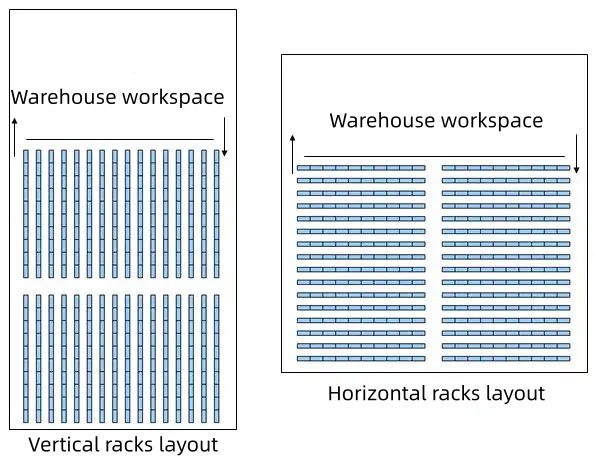
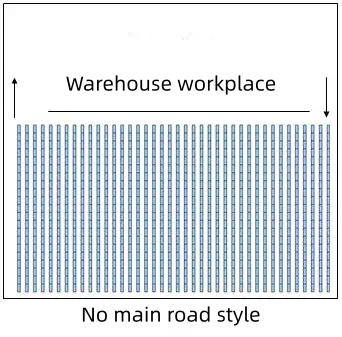
Warehouse rack layout also plays a role in improving warehouse storage and inbound outbound operational efficiency. So what types of warehouse rack layouts and warehouse configuration patterns are available? When discussing warehouse rack layouts in practical scenarios, two common types stand out: vertical layout and horizontal layout. Vertical and horizontal layouts are defined relative to the warehouse working area and entry exit direction, as illustrated in the figure below.
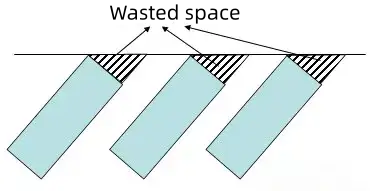
As can be seen from the above diagram, in both horizontal and vertical rack layouts, the longitudinal sides of racks run perpendicular to the main access aisle. This configuration is widely adopted in conventional warehouses. Why is this pattern so prevalent? To begin with, let us analyze e-commerce warehouse design, which derives from traditional warehouse design principles. For conventional warehouses (assuming a non circular footprint), aligning racks or pallet bays either perpendicular or parallel to the walls maximizes floor space utilization. Should racks or pallet positions be placed at an oblique angle to walls, valuable floor area will inevitably be wasted.
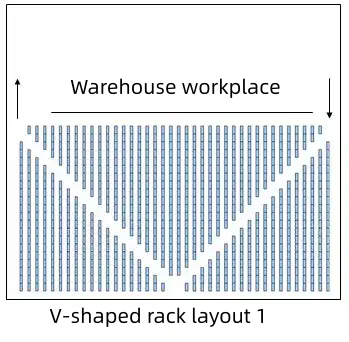
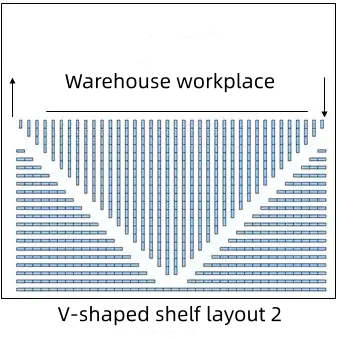
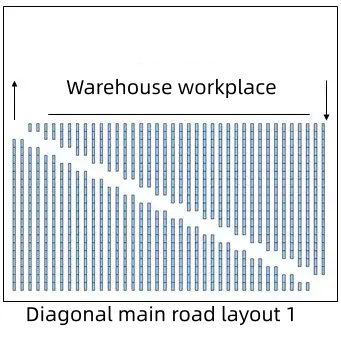
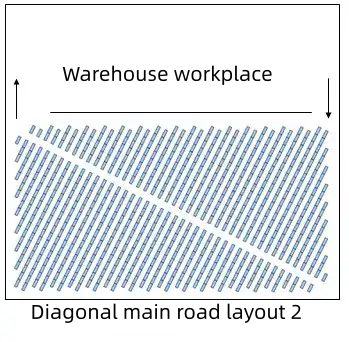
This layout logic works well for traditional warehouses. But is it absolutely optimal when applied to e-commerce warehouses? I once believed so, as it was the industry norm, until I read a technical article on warehouse rack design that offered new perspectives. The article presented two alternative rack layouts shown below.
According to tests cited in that foreign article, compared with the no-main-aisle layout shown below, V-type Layout 1 boosts operational efficiency by 11 %, while V-type Layout 2 delivers a 23 % efficiency gain.
What accounts for these efficiency improvements and the gap between the two performance figures? What motivates such departures from classic warehouse layout conventions? In the author’s view, the primary driver lies in picking efficiency priorities for e-commerce warehouses. Traditional warehouses feature low order fulfillment frequency, so picking time and picking efficiency are not critical constraints. By contrast, the order processing characteristics of e-commerce impose high demands on picking throughput. When floor space loss remains modest, modifying rack layouts to raise picking efficiency becomes a worthwhile option in warehouse management.
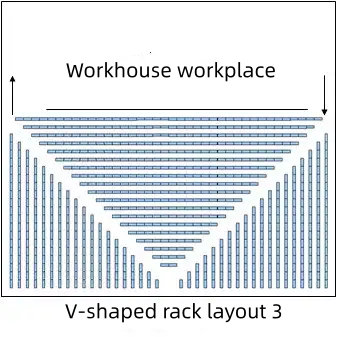
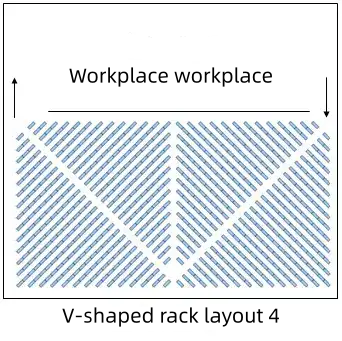
Inspired by the diagrams from that article, several further layout variants are conceived as shown in the following figures.
Warehouse layout, SKU assignment rules, order item distribution and other fine grained factors all exert influence on picking performance. Furthermore, determining optimal picking routes tailored to each rack layout scheme poses a nontrivial challenge. Businesses need thorough evaluation to select the rack layout solution best suited to their own operations.
StorLogi Carton Shuttle System leverages bi‑directional shuttles, AI‑driven scheduling, and active collision avoidance to achieve 2–3× storage density, 50%+ throughput gains, and an 18–24 month payback.
Our gantry loading & unloading system automates CNC turret punch press production. Reduce labor cost, improve safety and stable output. Fully compatible for cabinet, appliance and architectural sheet metal processing. Fast installation for SMEs.
 StorLogi