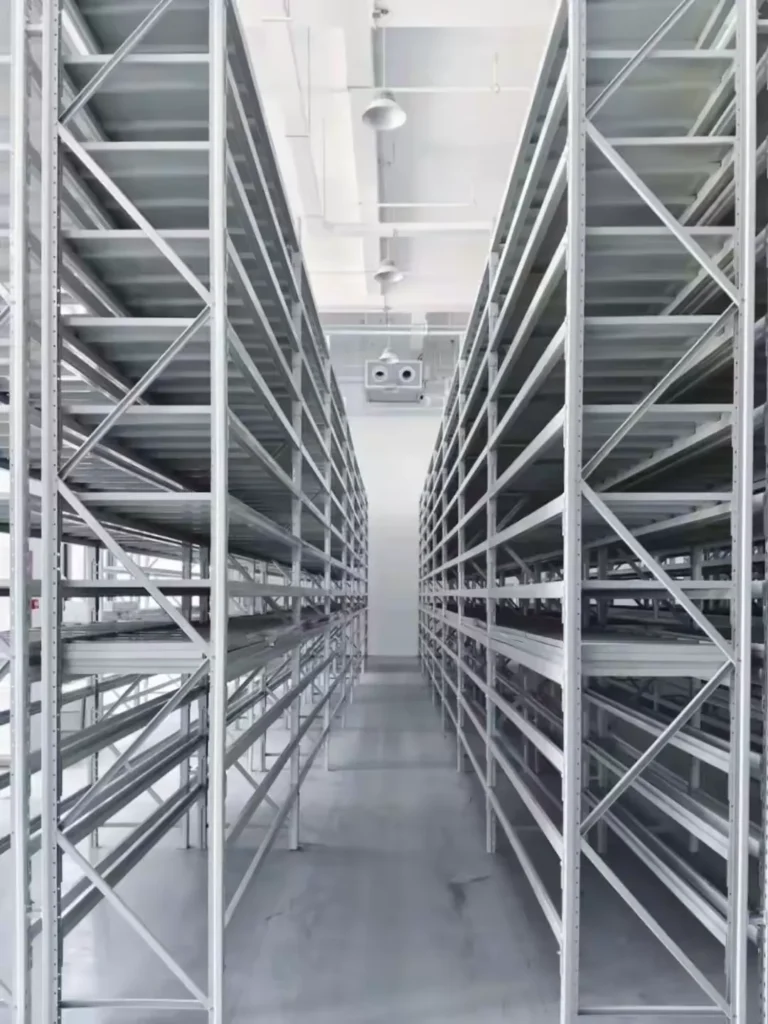
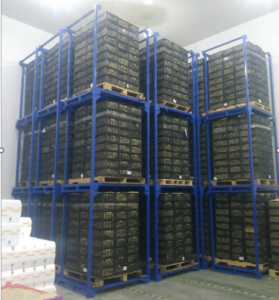
The project adopts assembled multi-layer heavy-duty shelving with hot-dip galvanized anti-rust steel structure and modular punching design. The floor height can be flexibly adjusted on demand to accommodate multi-specification goods such as cartons, material turnover boxes and precision component boxes.
Structural Advantages: Reinforced structure with upright columns and cross diagonal bracing delivers strong overall stability. It fully utilizes the vertical space of the factory building to expand multi-layer storage positions upward. With the same floor area, the warehouse capacity is more than 3 times that of ordinary flat warehouses.
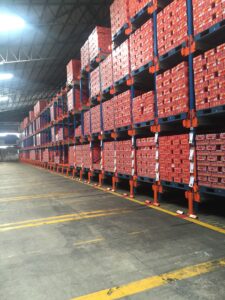
Scenario Adaptation: Neatly arranged narrow aisles are specially designed for AGV vehicles to travel. The aisle width is precisely calculated to support two-way scheduling of intelligent equipment while minimizing invalid aisle space and further improving warehouse space utilization.
Safety & Durability: The overall hot-dip galvanized anti-corrosion treatment resists moisture and collision, suitable for various industrial warehousing environments including electronics and machinery. It resists deformation under long-term heavy loads with a service life of over 15 years.
Neatly arranged multi-layer heavy-duty high racks with narrow aisles designed for AGV vehicle passage.
AGV Intelligent Handling System
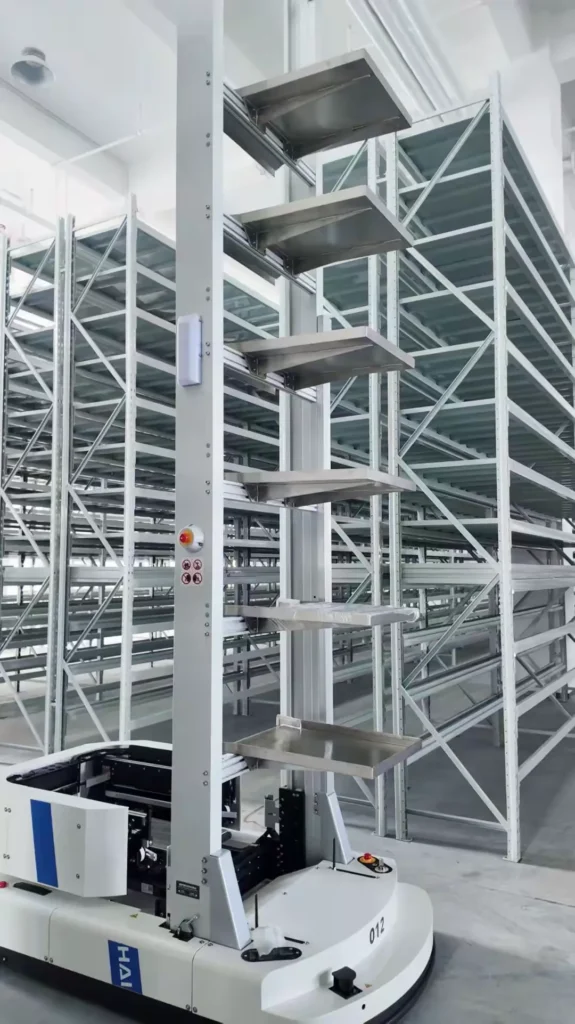
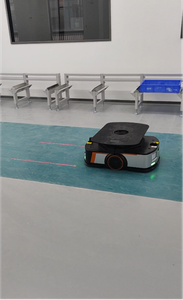
The AGV intelligent stacking handling robot is the core equipment for automated operations of this system. It replaces traditional manual forklifts and pallet trucks to independently complete goods transfer, high-level storage and picking within rack aisles.
Autonomous Navigation Operation: Supported by laser navigation technology, AGVs can independently plan optimal driving routes, automatically avoid obstacles and accurately dock at cargo positions. Uninterrupted cyclic operations can be realized 24 hours without manual driving.
High-level Access Compatibility: Equipped with vertical lifting forks, it matches multi-layer high racks to realize material access from ground to high-level storage positions, solving the pain point of inefficient manual high-level loading and unloading.
Cluster Scheduling Management: Multiple AGVs can be connected to a unified scheduling system to simultaneously perform inbound, outbound and restocking tasks without route conflicts or task congestion, greatly boosting warehouse throughput during peak periods.
AGV stacking vehicles can independently complete material storage, picking and transfer operations.
Automated Roller Conveying Assembly Line
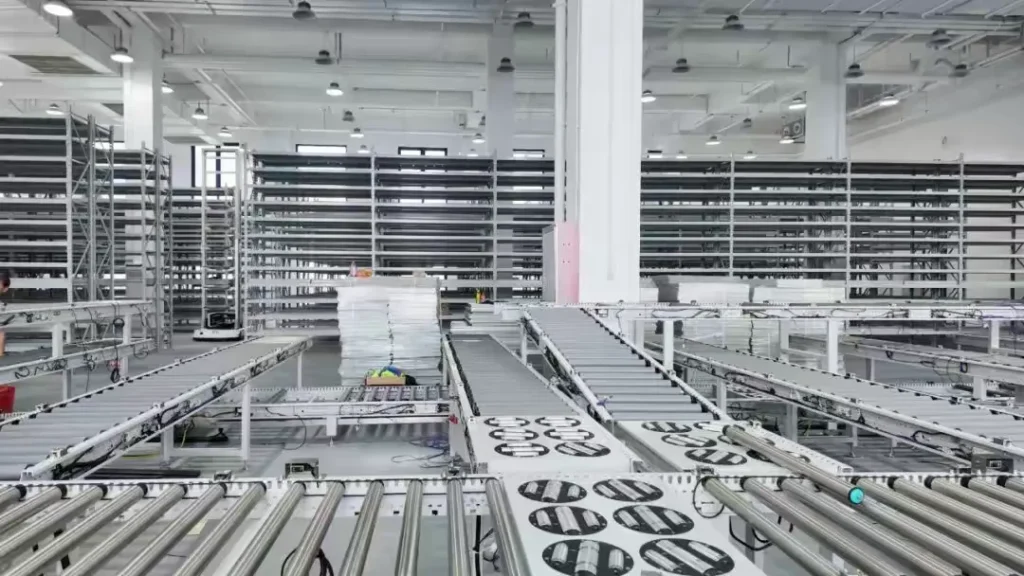
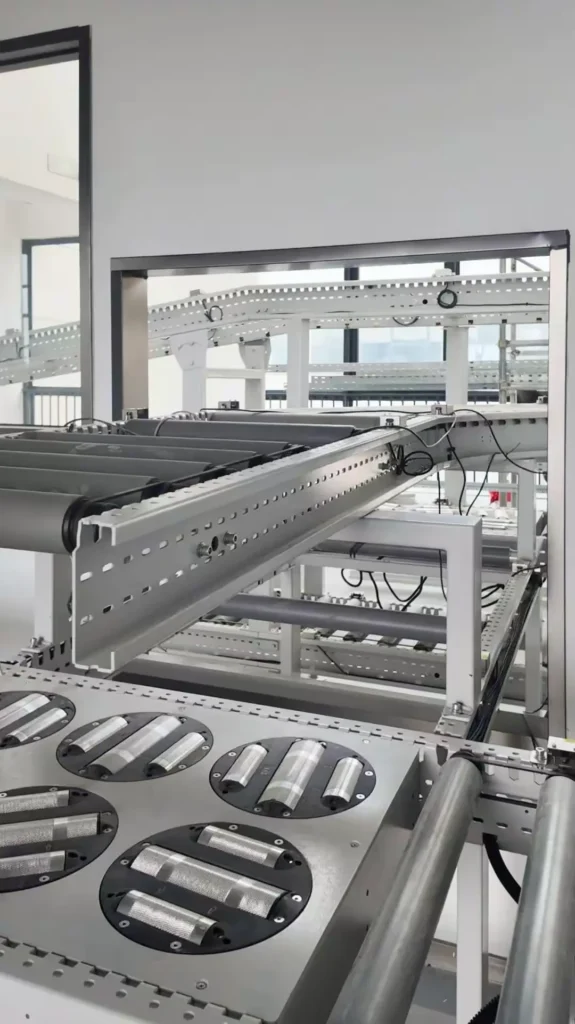
Roller conveyors, transfer docking tables and vertical lifting mechanisms form a material transfer network serving as the material docking hub between warehouses and production workshops. They realize seamless automatic transfer of goods from production lines to warehouse areas and from warehouse areas to sorting stations.
Stable & Efficient Conveyance:Heavy-duty galvanized roller conveying structure boasts strong load capacity and stable, low-noise operation. It can continuously transport turnover boxes and full cartons, eliminating goods collision, dropping and loss caused by manual handling.
Flexible Docking Design:Equipped with transfer machines and vertical lifting docking devices, it supports multi-directional material circulation and cross-floor transfer, flexibly matching the workflow demands of multiple operation areas including warehousing, sorting and production.
Electric Intelligent Linkage:The conveying line is equipped with photoelectric sensors and start-stop electric control systems, which can link with AGVs and WMS systems to realize automatic start-stop upon goods arrival and automatic restocking calls for material shortages, requiring no on-site manual operation throughout the process.
Warehouse docking roller conveyor lines realize automatic transfer and intelligent start-stop control.
II. Warehouse Pain Points Solved by the System
Expand Storage Capacity by Utilizing Vertical Space:Traditional warehouses only utilize ground floor space while high-rise areas remain idle, leading to flat stacking and rapid capacity saturation. Multi-layer high racks fully leverage factory ceiling height to build three-dimensional multi-layer storage zones. Without adding factory buildings or renting external warehouses, storage capacity can be multiplied, greatly cutting extra costs of site leasing and off-site warehouse management. Meanwhile, narrow aisle layout reduces invalid space and optimizes warehouse utilization to maximize storage value of every square meter of factory space.
Reduce Labor Reliance to Cut Costs & Boost Efficiency:Traditional warehousing requires a large number of warehouse staff and forklift operators for handling, storage and picking. Labor costs rise year by year with frequent staff turnover and slow onboarding of new employees, making stable operational efficiency hard to maintain.This intelligent system replaces over 80% of repetitive manual handling work via AGVs and conveying lines. Only a small number of staff are needed for system scheduling, exception handling, quality inspection and packaging. It not only streamlines labor allocation but also steadily improves inbound and outbound efficiency without labor bottlenecks during order peaks. Additionally, it avoids losses caused by manual errors such as wrong delivery, missing shipment and goods damage.
Standardize Inventory Management with Full Material Traceability:Multi-layer racks are divided into exclusive storage positions based on SKUs, batches and material types. Combined with the WMS warehouse management system, one unique code is assigned to each material and each storage position. The warehousing time, storage location and outbound flow of every batch of materials can be fully traced. The system automatically follows the first-in-first-out principle to effectively prevent backlog, stagnation and expiry loss of raw materials and semi-finished products. Manual piece-by-piece inventory counting is replaced by one-click system statistics.
Connect Warehouse & Production to Stabilize Production Rhythm:Many manufacturing enterprises face disjointed material circulation between warehouses and production lines, often resulting in production shutdown due to material shortages or piled-up materials beside production lines. Automated conveying lines directly connect warehouse zones and production stations. AGVs automatically deliver materials to docking conveyor lines according to production work orders, and materials are transported directly to production stations via assembly lines for precise on-demand supply. This eliminates production halts from material shortages and excessive material accumulation beside lines, stabilizing production rhythm and supporting lean production management for enterprises.
Many factory warehouses, cold chain cold storage facilities and auto parts workshops face common pain points: messy cargo stacking, low space utilization and cumbersome handling & circulation. Goods stacked on conventional pallets tend to col...
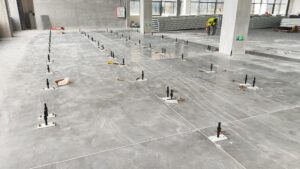
Recently, the heavy-duty storage rack project for the industrial park undertaken by our company in Guangzhou has entered the intensive on-site construction phase. Our construction team proceeds with operations in strict accordance with installati...
Custom radio shuttle racking system for high‑density automated warehouse storage. Supports FIFO & LIFO, ideal for food, beverage, cold‑chain, FMCG and bulk pallet goods. Improve warehouse space utilization and logistics efficiency with our reliabl...
 StorLogi