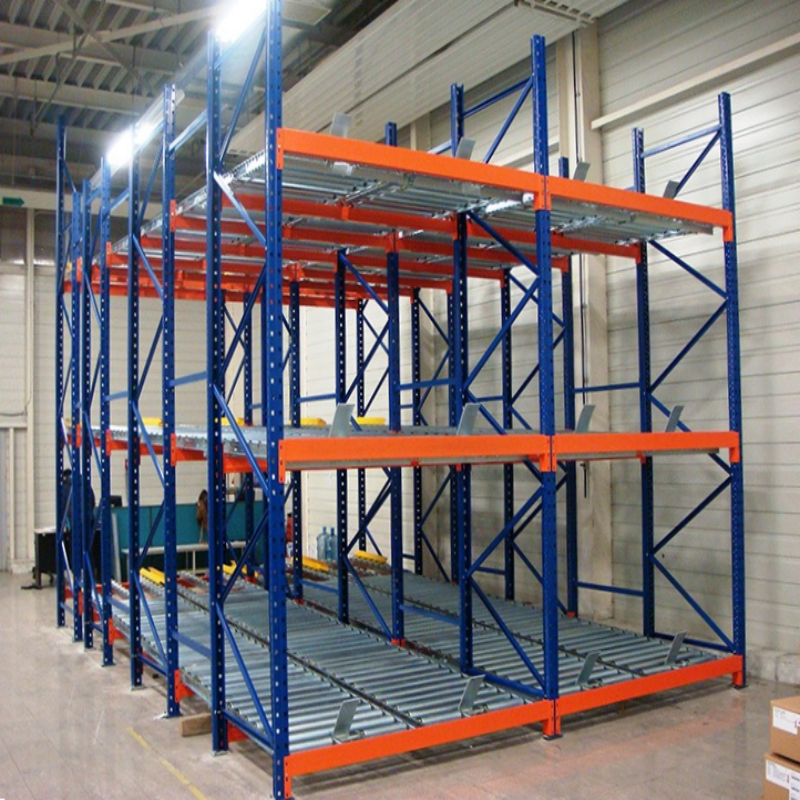
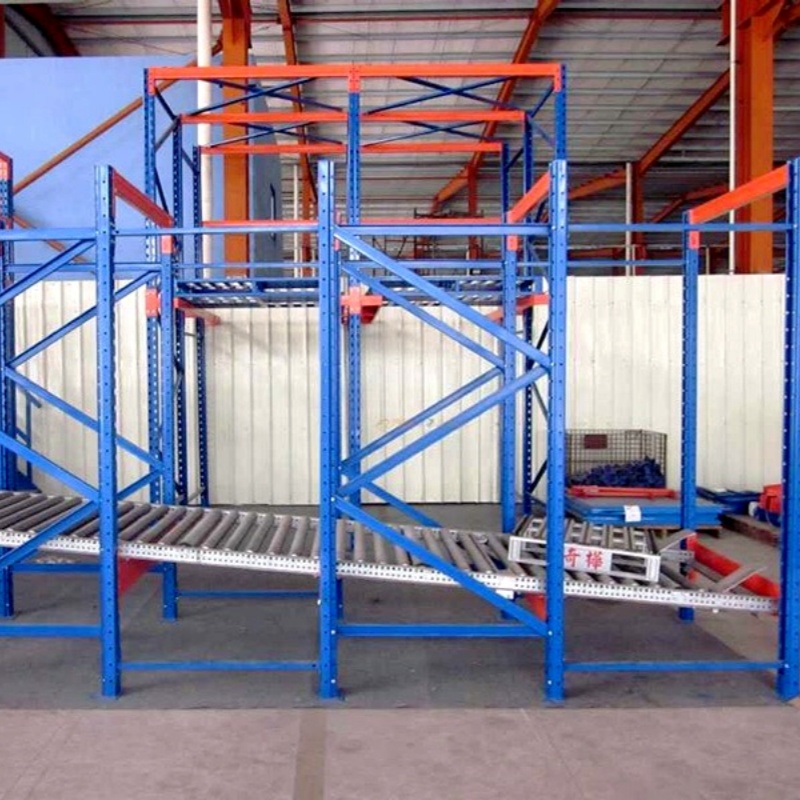
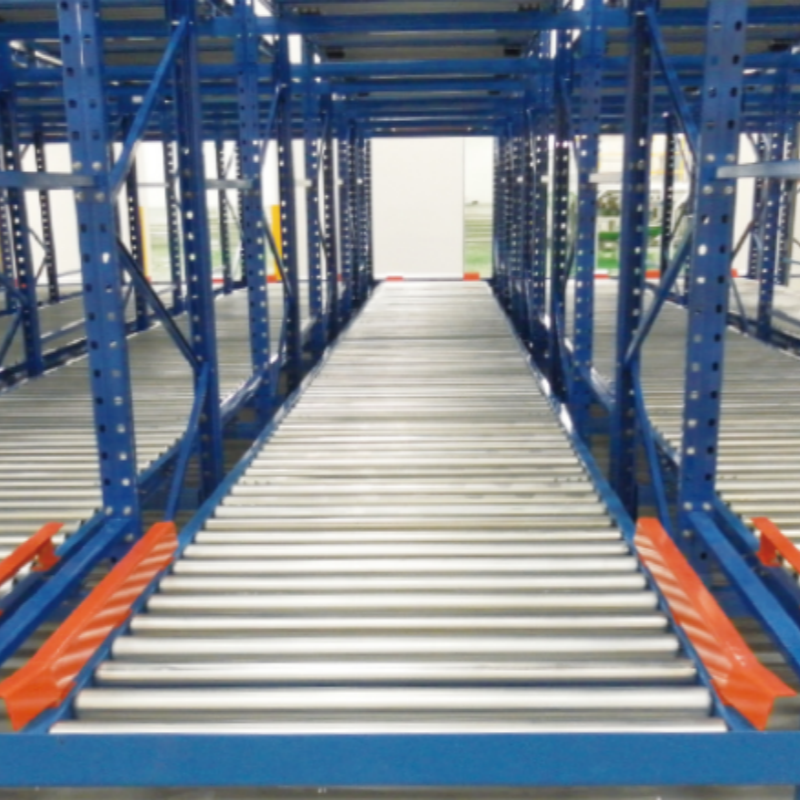
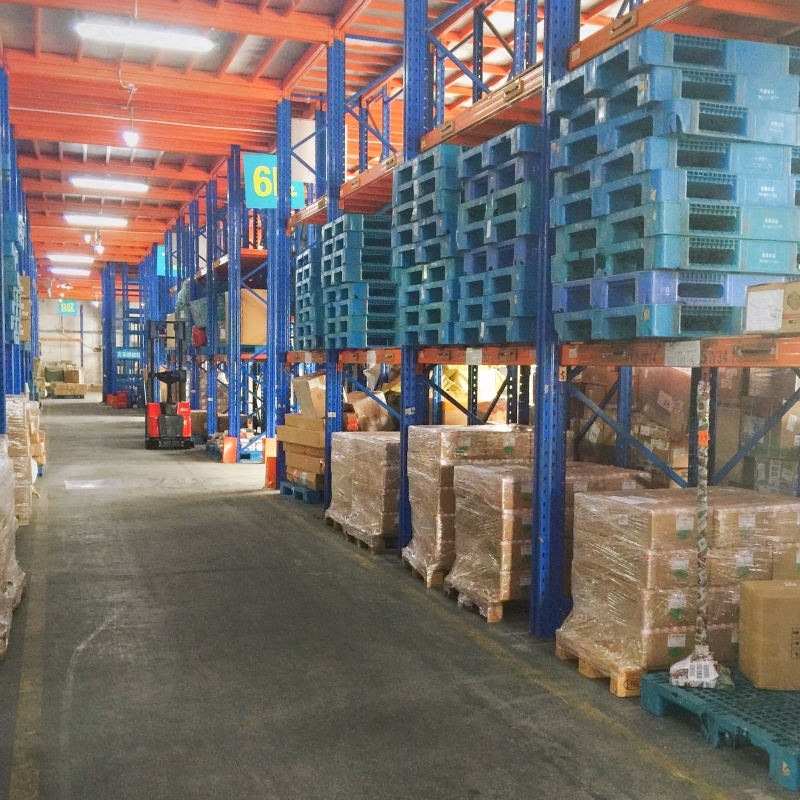
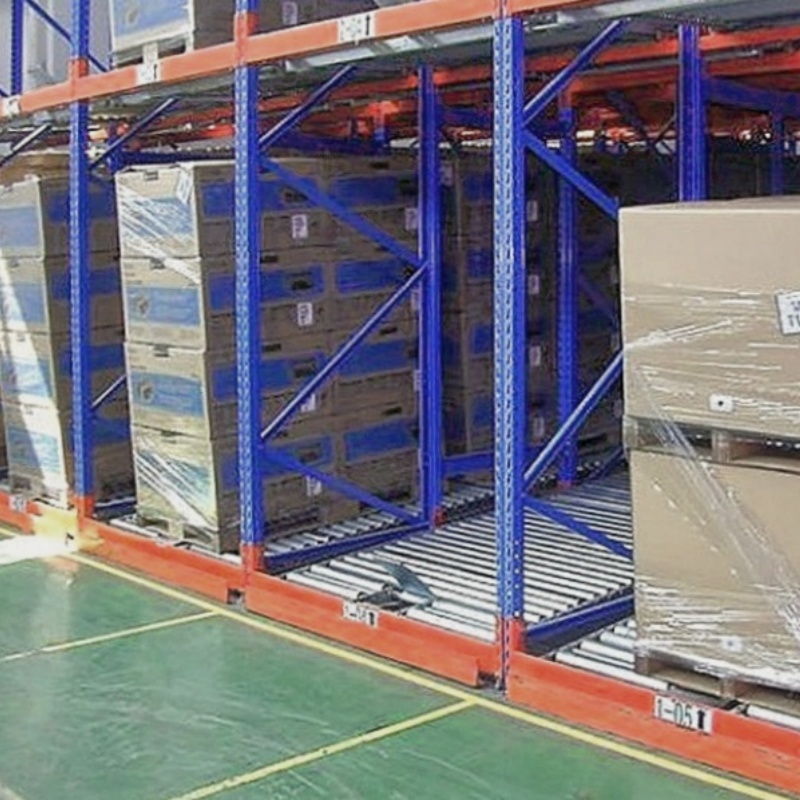
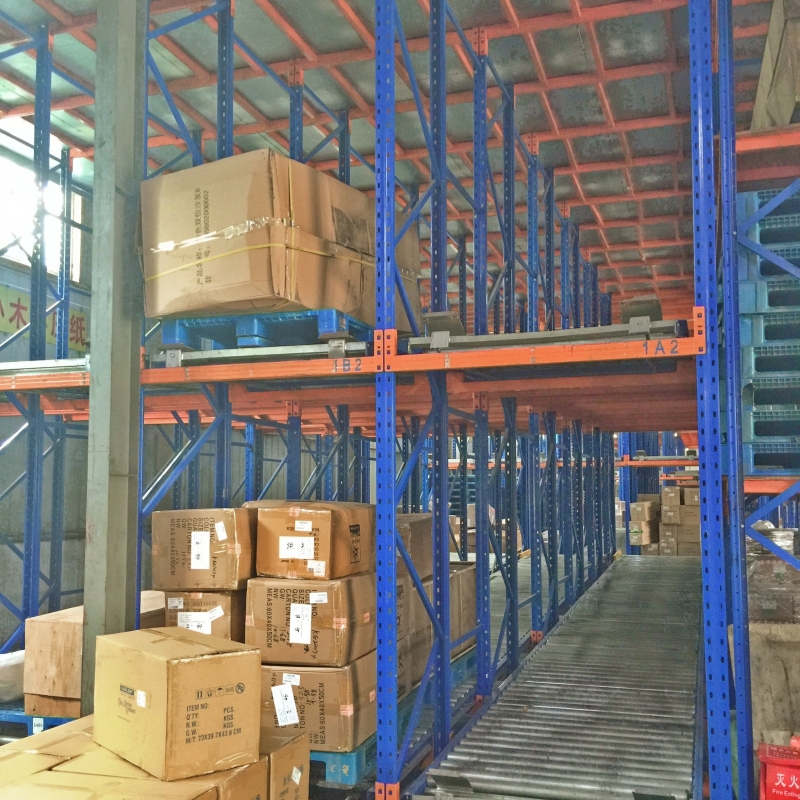
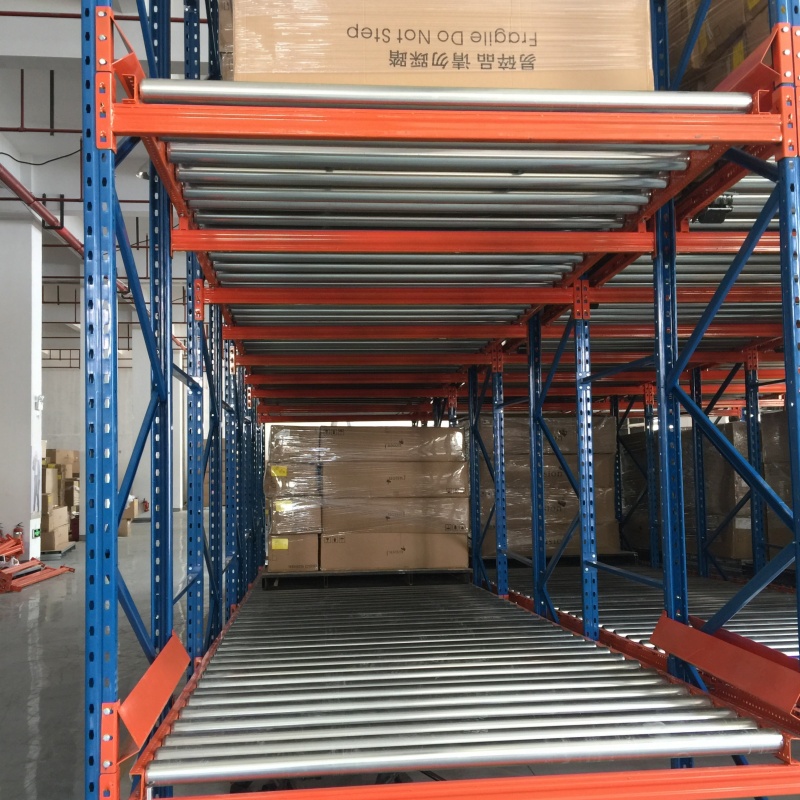
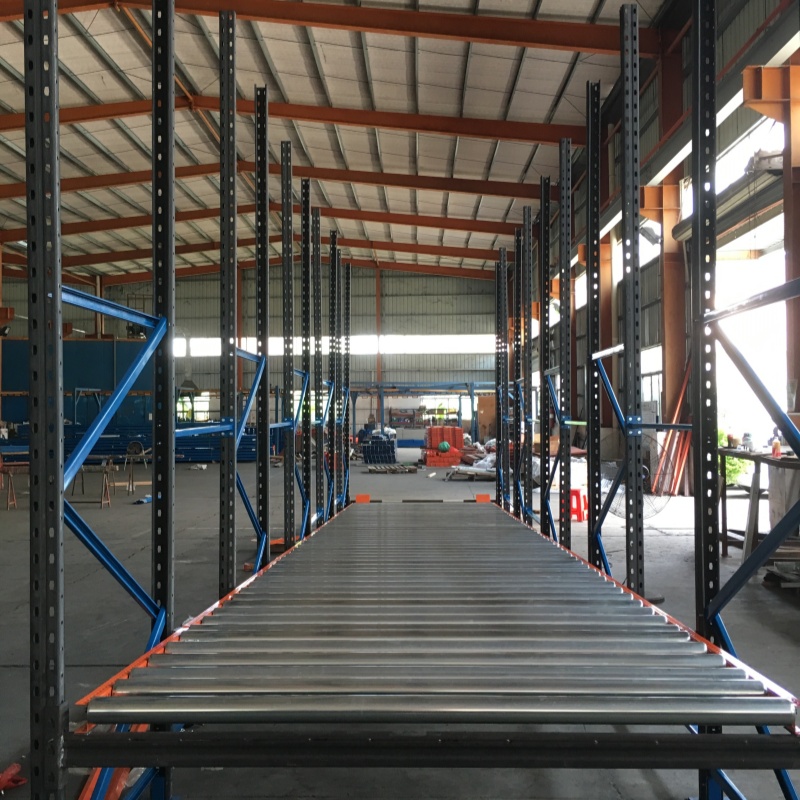
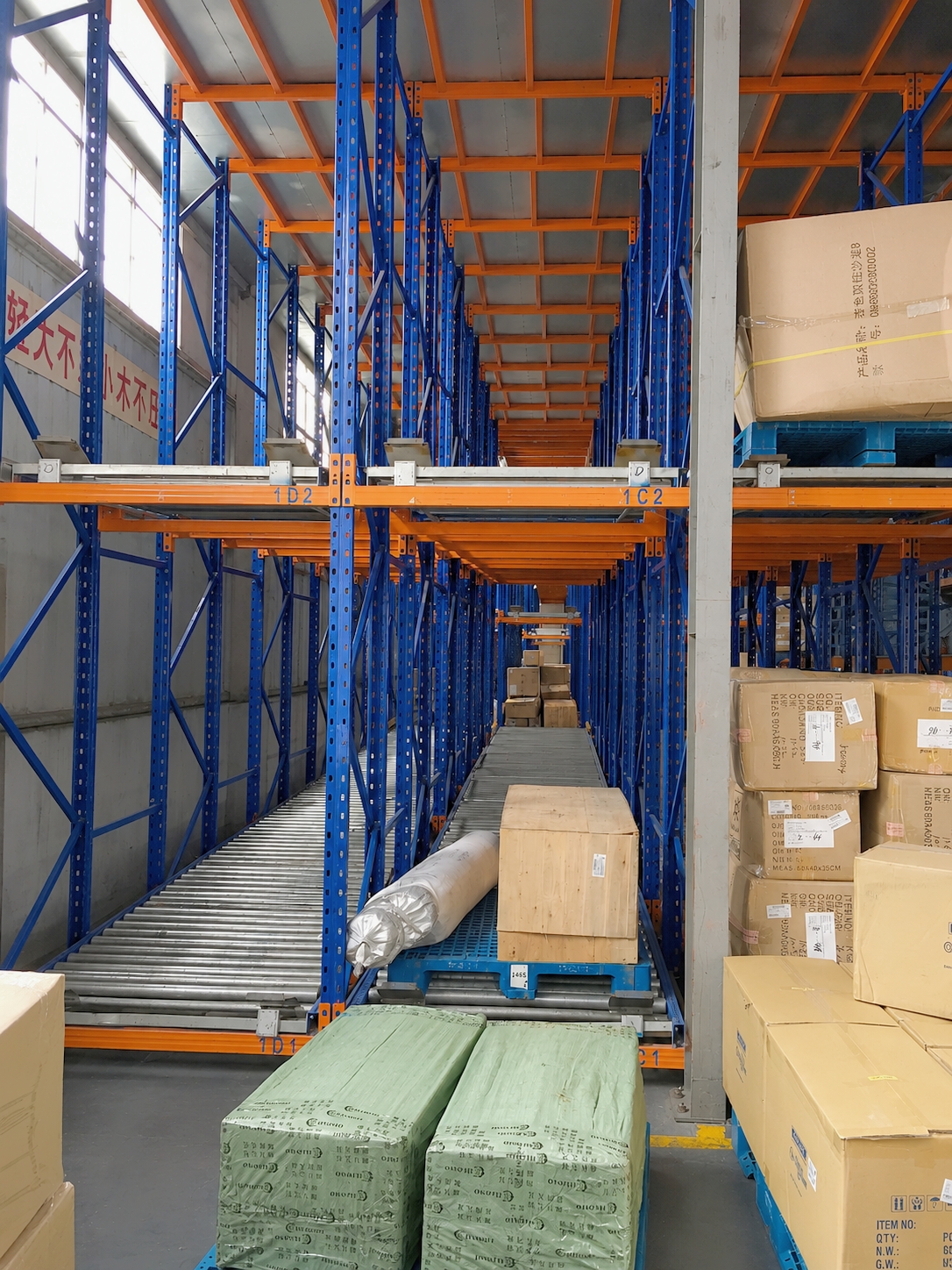
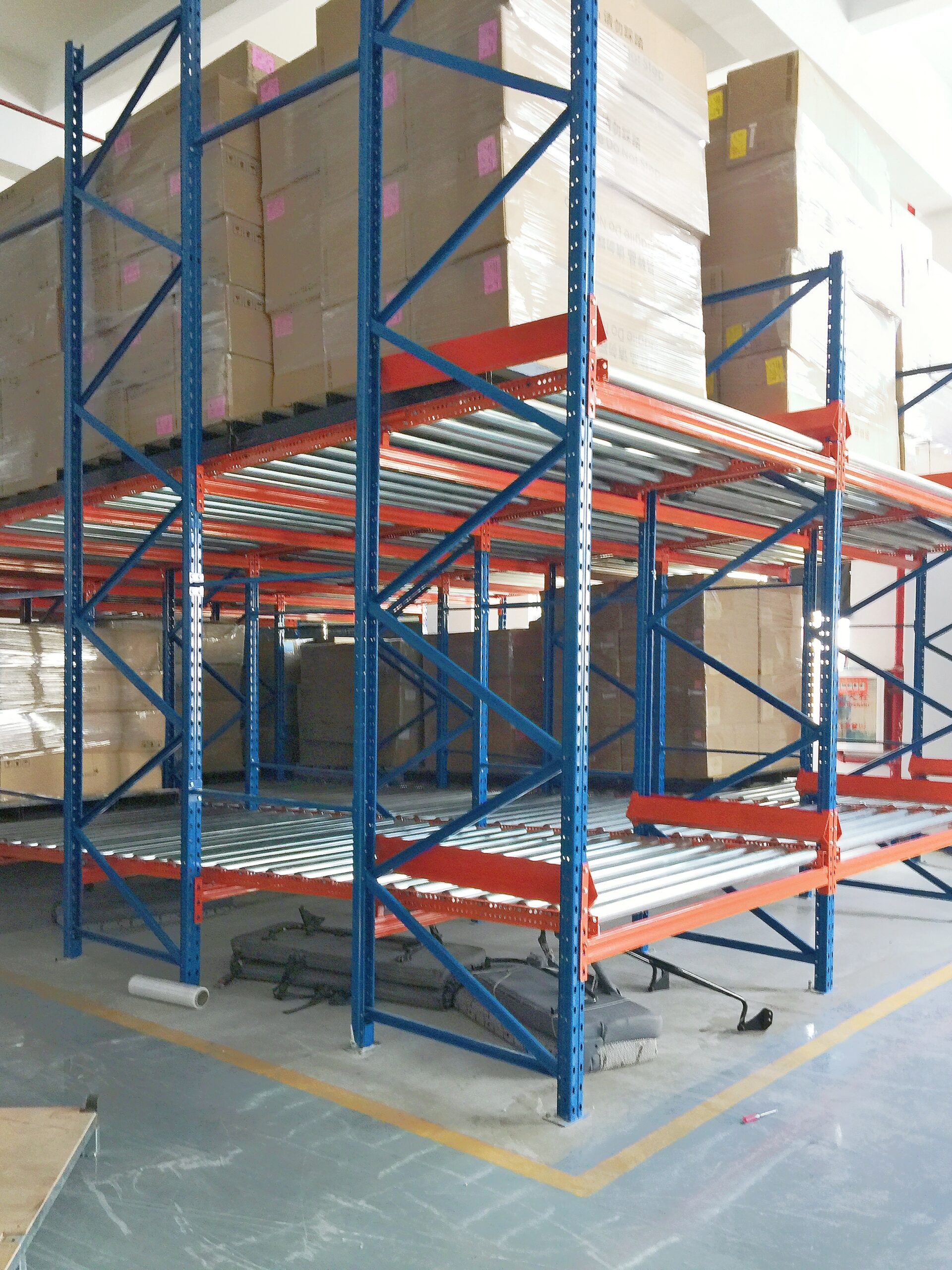
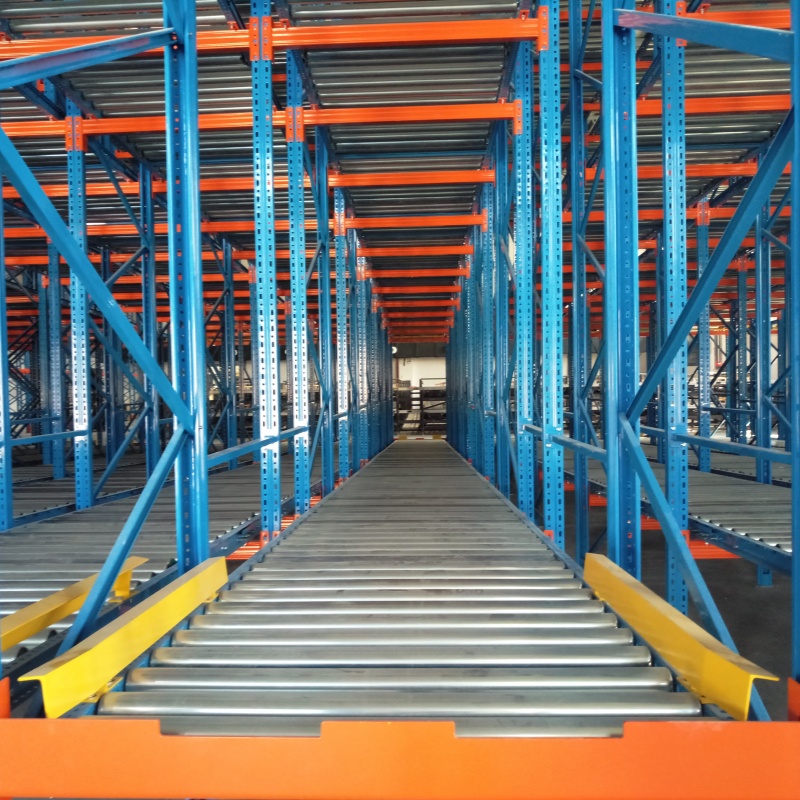
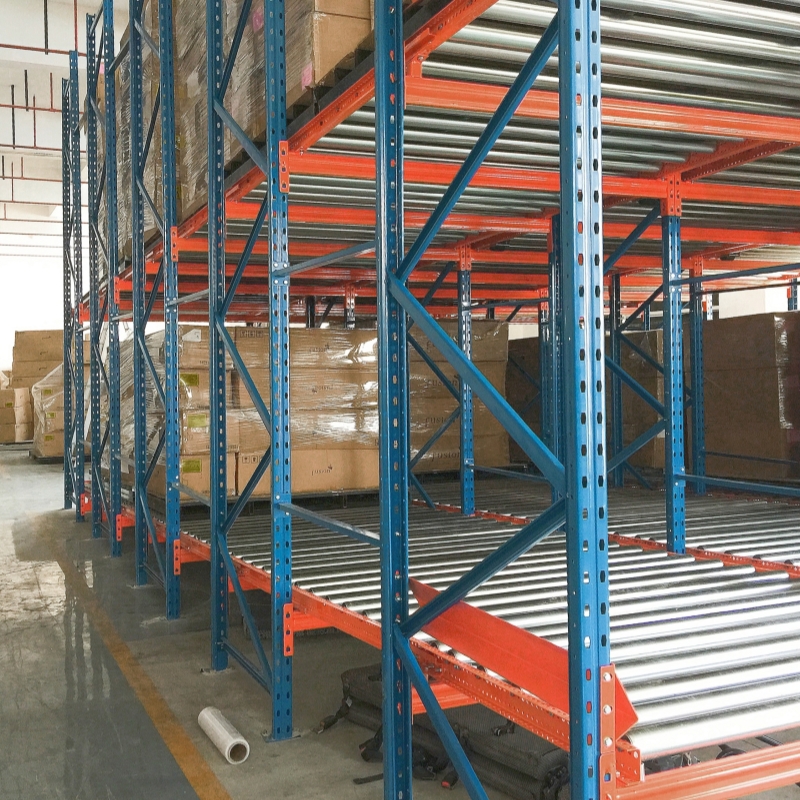
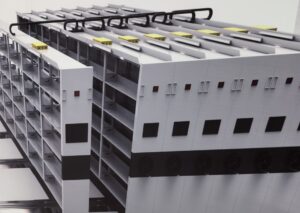
Gravity racks, also called self-gravity racks, have roller tracks installed on the beams that are tilted at a 3°~5° angle. They use the weight of the goods to make them move, allowing for a first-in, first-out system—goods go in from one side and come out from the other. They’re great for storing large quantities of the same type of item efficiently, making the most of the space. They’re especially useful for products with a shelf life that shouldn’t be stored for too long.
I.Main structure
The structural design of gravity racks is the foundation of their efficient operation, and they mainly consist of the following key components:
1. Inclined Roller Tracks: Roller guides are installed on the rack beams, and the tracks are inclined at an angle of 3° to 5°. This is the core structure that allows goods to slide smoothly under their own weight.
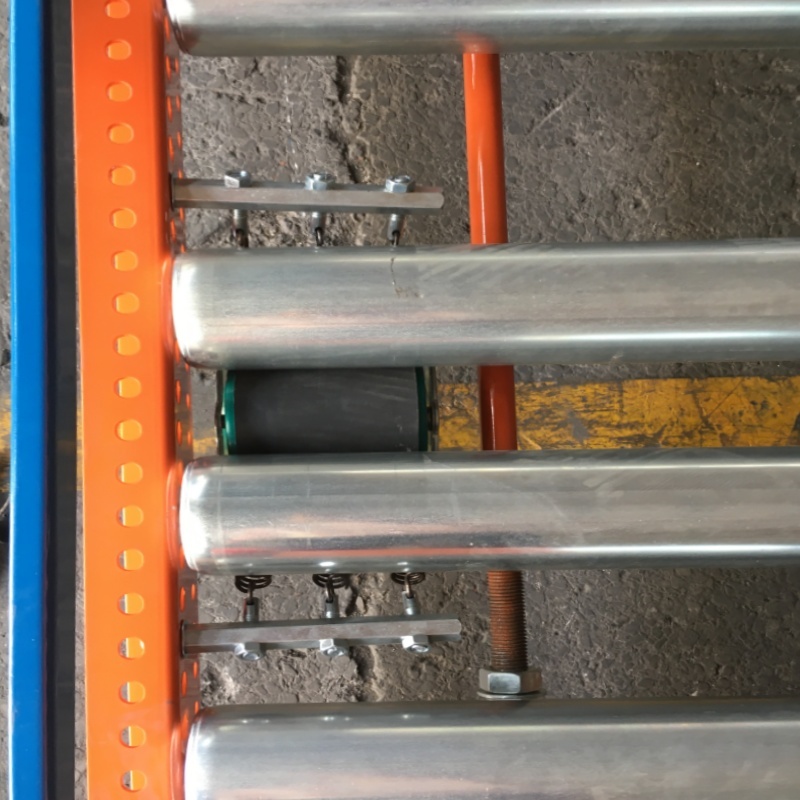
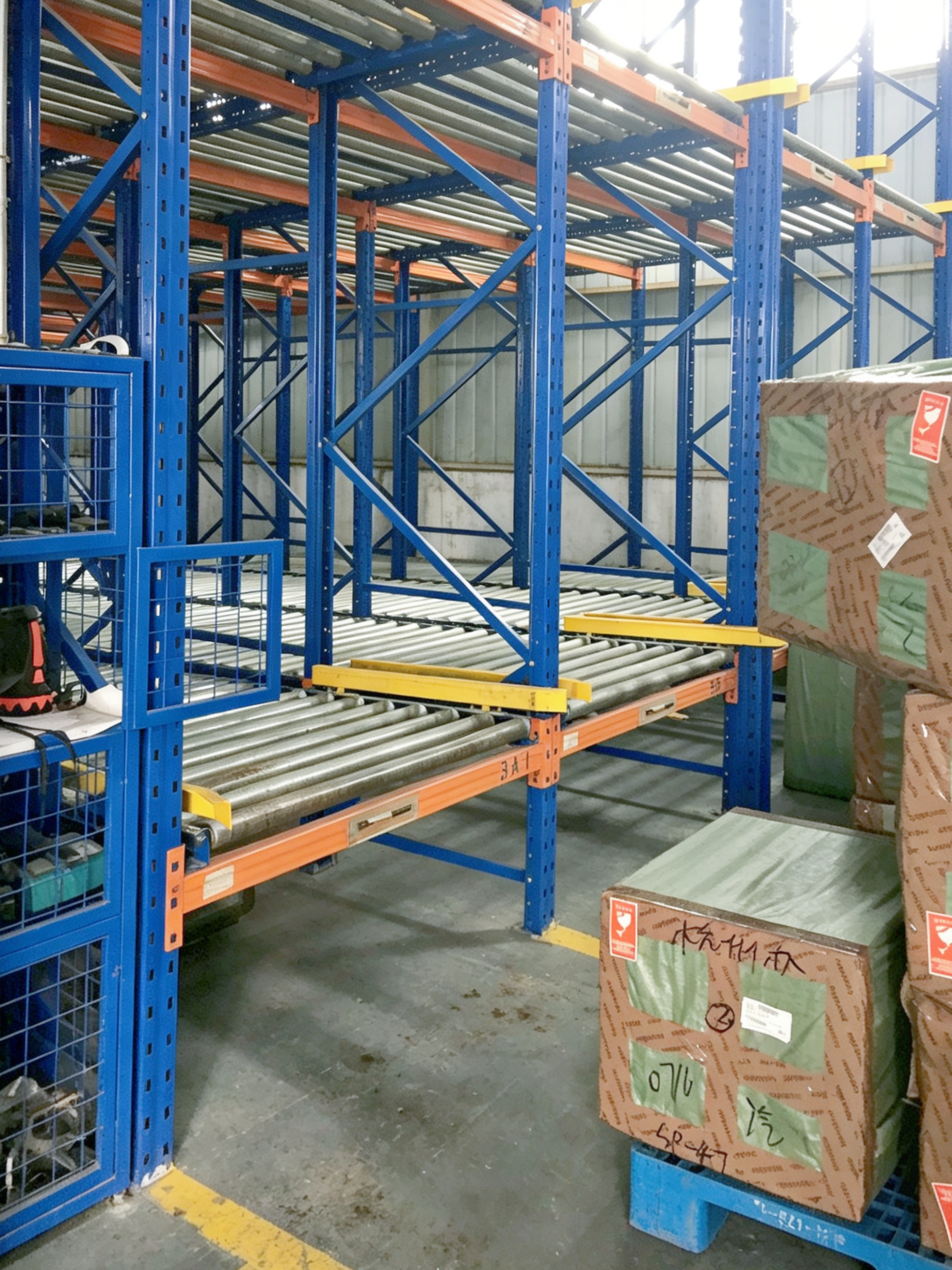
2. Dampers and Buffer Devices: To ensure smooth sliding, especially on longer lanes, dampers are added in the middle of the tracks. To prevent pallets from tipping due to excessive impact when sliding to the bottom, buffers are installed at the lowest point of the lane. Additionally, automatic pallet separation devices are placed at the lower end of the track for easier picking.
3. Separators: Automatic pallet separation devices are set at the lower end of the track to maintain a safe distance between the pallet to be picked and the following pallets, making it easier and safer for forklifts or handling machinery to pick up the first pallet.
II. Operating Process
Gravity racks use a “last in, first out” one-way flow system, with storage and retrieval completely separated:
1. Inbound operation: Forklifts move palletized goods to the high end of the rack (loading side). The goods are placed on roller tracks and slide down automatically due to their own weight.
2. Internal flow: Goods slide down at a constant speed controlled by dampers. When goods are taken at the retrieval end, the following goods automatically slide forward to fill the empty space, achieving automatic replenishment.
3. Outbound operation: Forklifts directly pick up the front goods at the low end of the rack (retrieval side). Throughout the process, forklifts don’t need to enter the aisle inside the rack, only operating at the two ends.
III. Core Advantages
1. Maximum Space Utilization: No need to leave forklift lanes between rack groups. With a dense flow lane design, warehouse space utilization can reach over 75%, saving 35%-65% of storage space compared to traditional pallet racks.
2. Forced First-In-First-Out: The physical structure ensures that goods slide out in the order they were stored, fundamentally eliminating backlog and expiration risks. It’s especially suitable for items with high time sensitivity.
3. Efficient and Energy-Saving: Separating storage and retrieval operations prevents interference between inbound and outbound processes, greatly improving efficiency. The system is fully gravity-driven with no power needed, which means zero energy consumption and very low noise.
IV. Applicable Scenarios
Gravity racks are mainly suitable for the following specific situations:
1. Low variety, high-volume storage: Each lane usually only stores one type of item, making it perfect for warehouses with few SKUs but very large quantities of each.
2. Time-sensitive industries: Widely used in food and beverage, pharmaceuticals, cold chain logistics, and other sectors where products have strict shelf life limits and first-in, first-out must be ensured.
3. Production line material supply: In manufacturing, they can serve as a side or buffer warehouse to ensure materials are supplied to the production line continuously and in order.
V. Things to Keep in Mind
When planning and using gravity flow racks, you need to strictly consider the following limitations:
1. Height and Load Limits: To ensure reliable and safe operation, the rack height is generally kept under 6 meters, and the load per pallet usually shouldn’t exceed 1000kg to 1500kg.
2. Cargo Specifications: Pallets and packaging must be uniform in size, have flat bottoms, and be structurally stable. Irregular, too-light, or loosely packed goods can easily cause jams or uncontrolled slips.
3. Design and Installation Accuracy: The tilt angle, spacing of dampers, and tuning of buffers require a high level of expertise. If the slope is too steep or the track too long, the sliding force can be too strong; improper installation can create safety hazards.
4. Maintenance Costs: Although there’s no power consumption, the rollers and tracks are parts that wear out easily, so it’s necessary to regularly clean dust, check for wear, and replace damaged components to maintain smooth sliding performance.
Gravity racks, with their key advantages of ‘first in, first out’ and high-density storage, effectively solve the storage problems of large volumes of time-sensitive goods. Although they have some requirements for the specifications of the goods, their non-powered, high-efficiency features make them an ideal choice for improving warehouse turnover and reducing operating costs.
StorLogi’s bridge-style corridor racking converts overhead aisle space into pallet positions, boosting storage density per sqm and cutting warehouse costs with modular, industrial-grade design.
In modern intelligent manufacturing and production line logistics systems, conveyor systems are the core link connecting "equipment-process-capacity". Based on the production characteristics of different industries, we provide end-to-end solution...
In enterprises, public institutions, libraries, research institutes, and precision parts warehouses, traditional storage faces critical pain points: massive document accumulation, insufficient space utilization, low retrieval efficiency, and poor...
At Storlogi, we redefine industrial storage through a seamless blend of advanced manufacturing, rigorous quality control, and customer-centric innovation. Our state-of-the-art facilities (as showcased in our production ecosystem) exemplify our co...
 StorLogi