Core Value of Automated Storage & Retrieval System (AS/RS)
The core value of an automated storage & retrieval system (AS/RS) lies not only in its high-density racking structure, but more importantly in the precise collaboration between intelligent equipment such as stackers and the racking system.
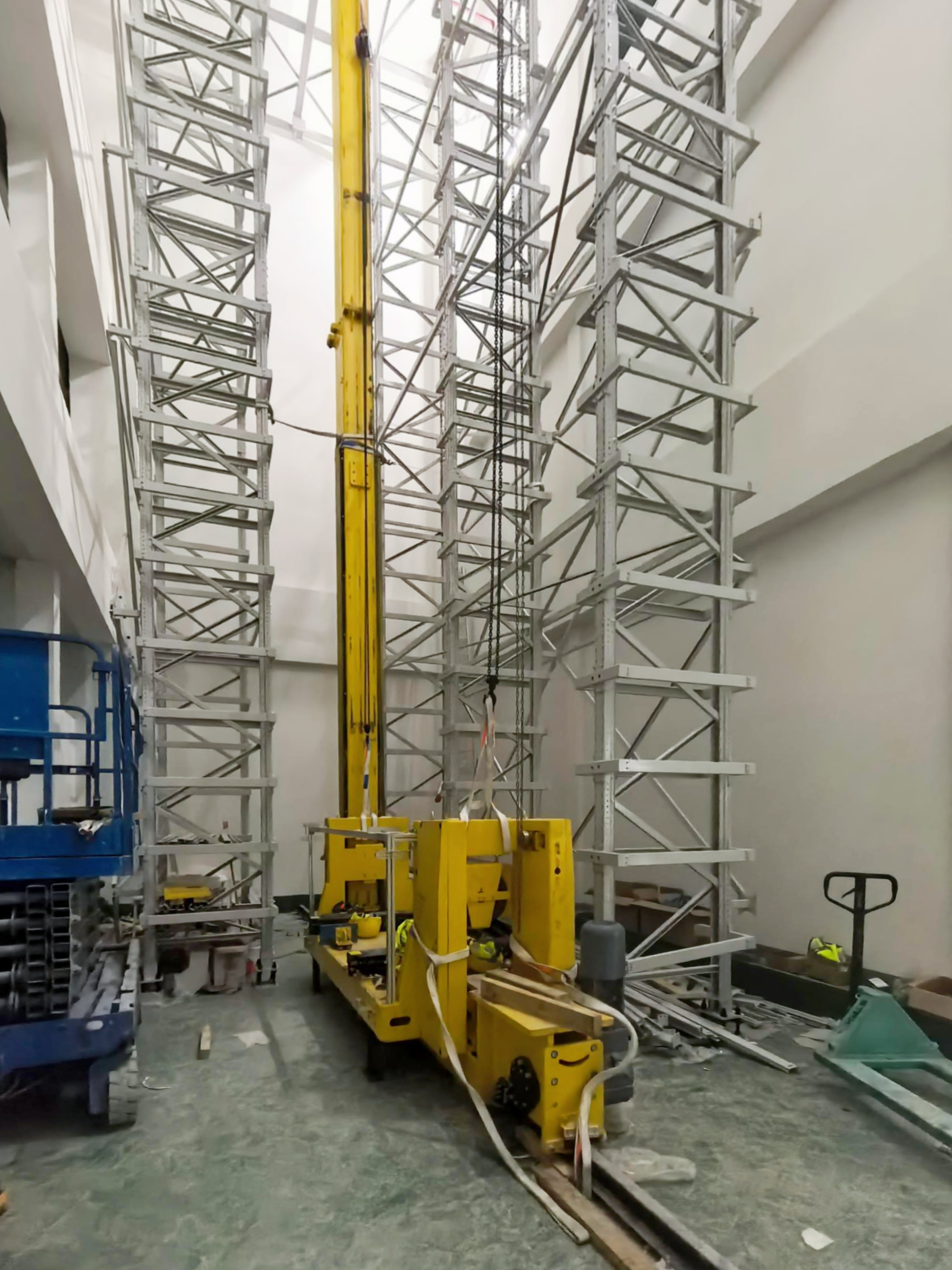
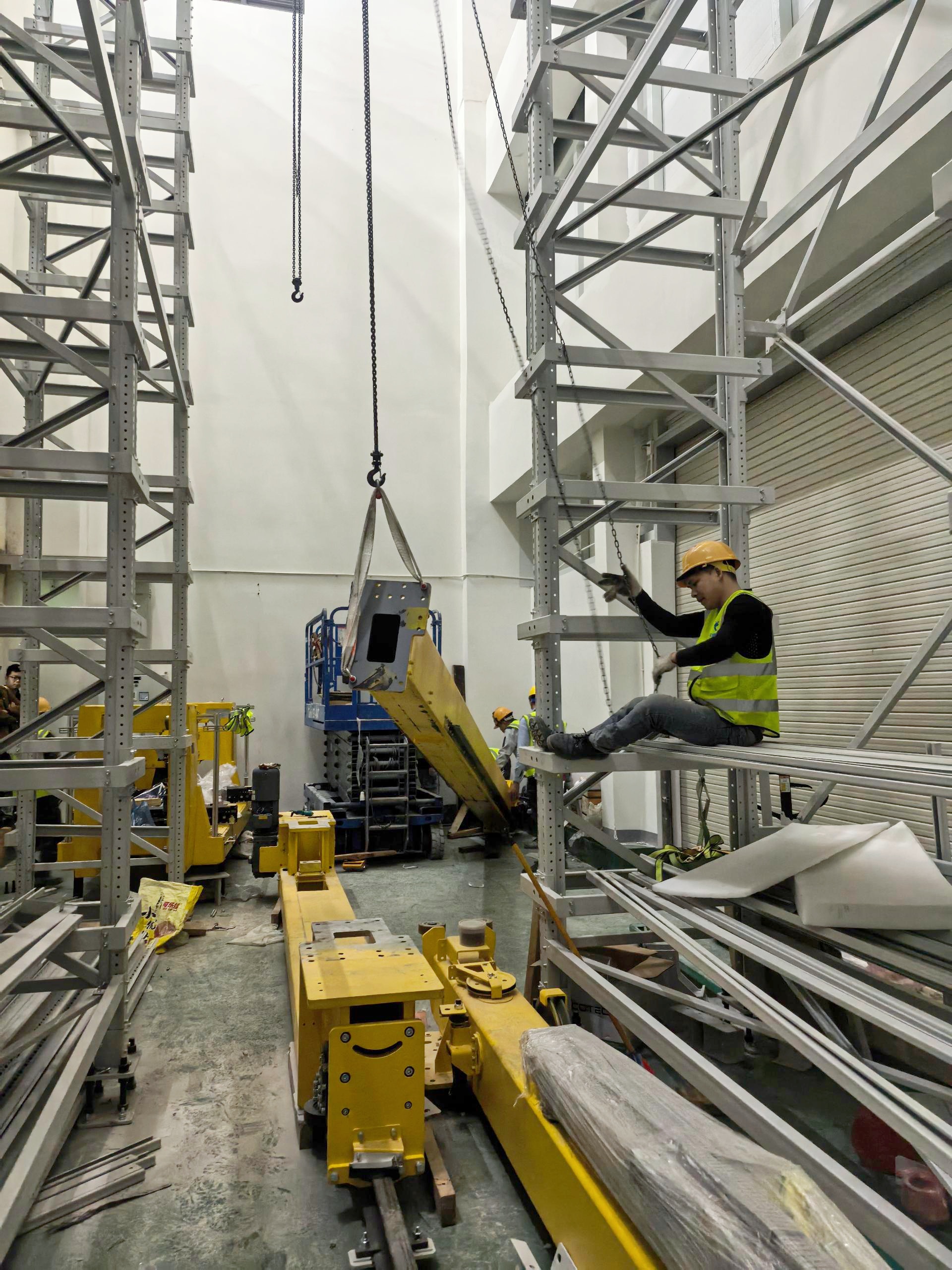
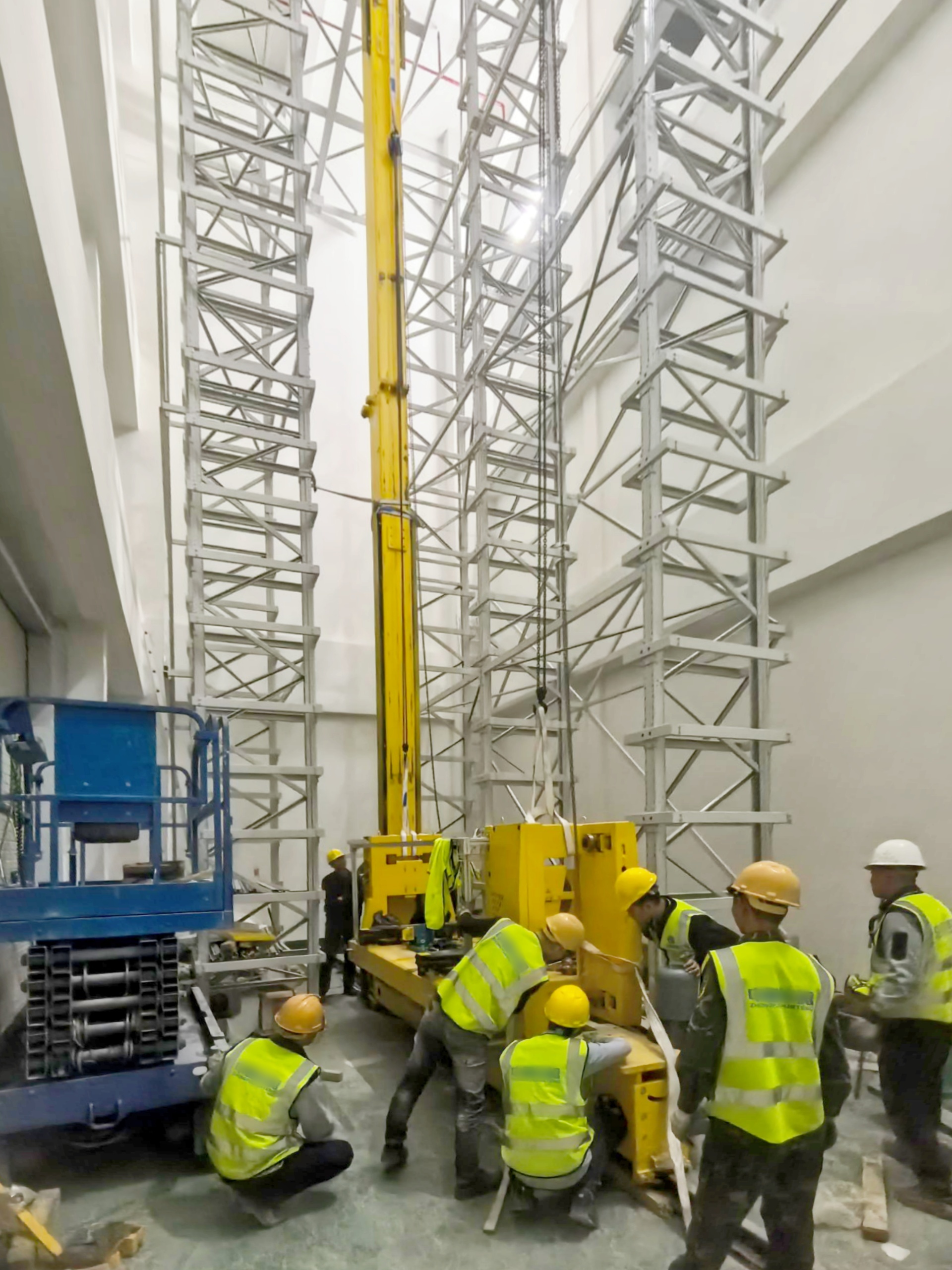
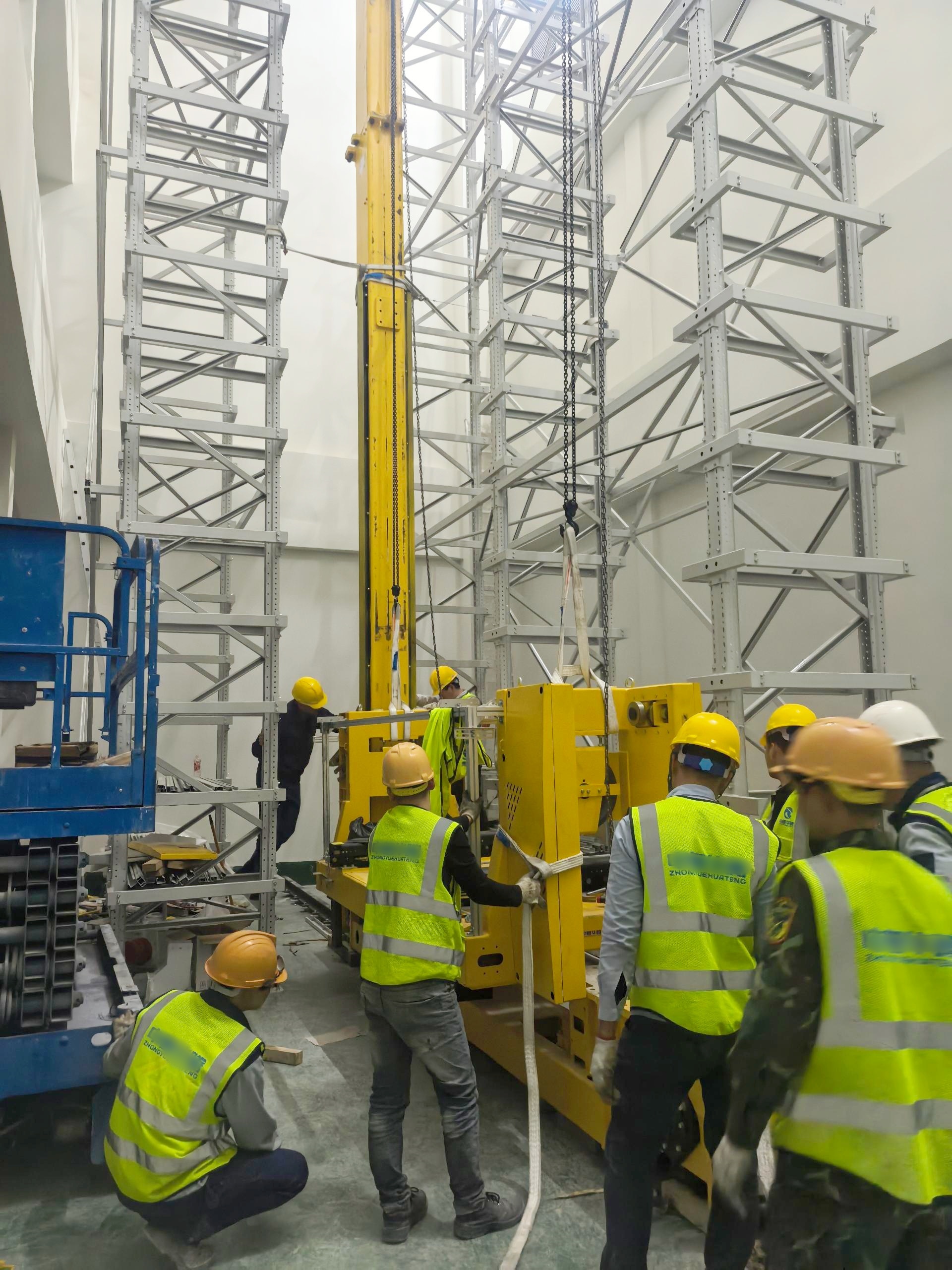
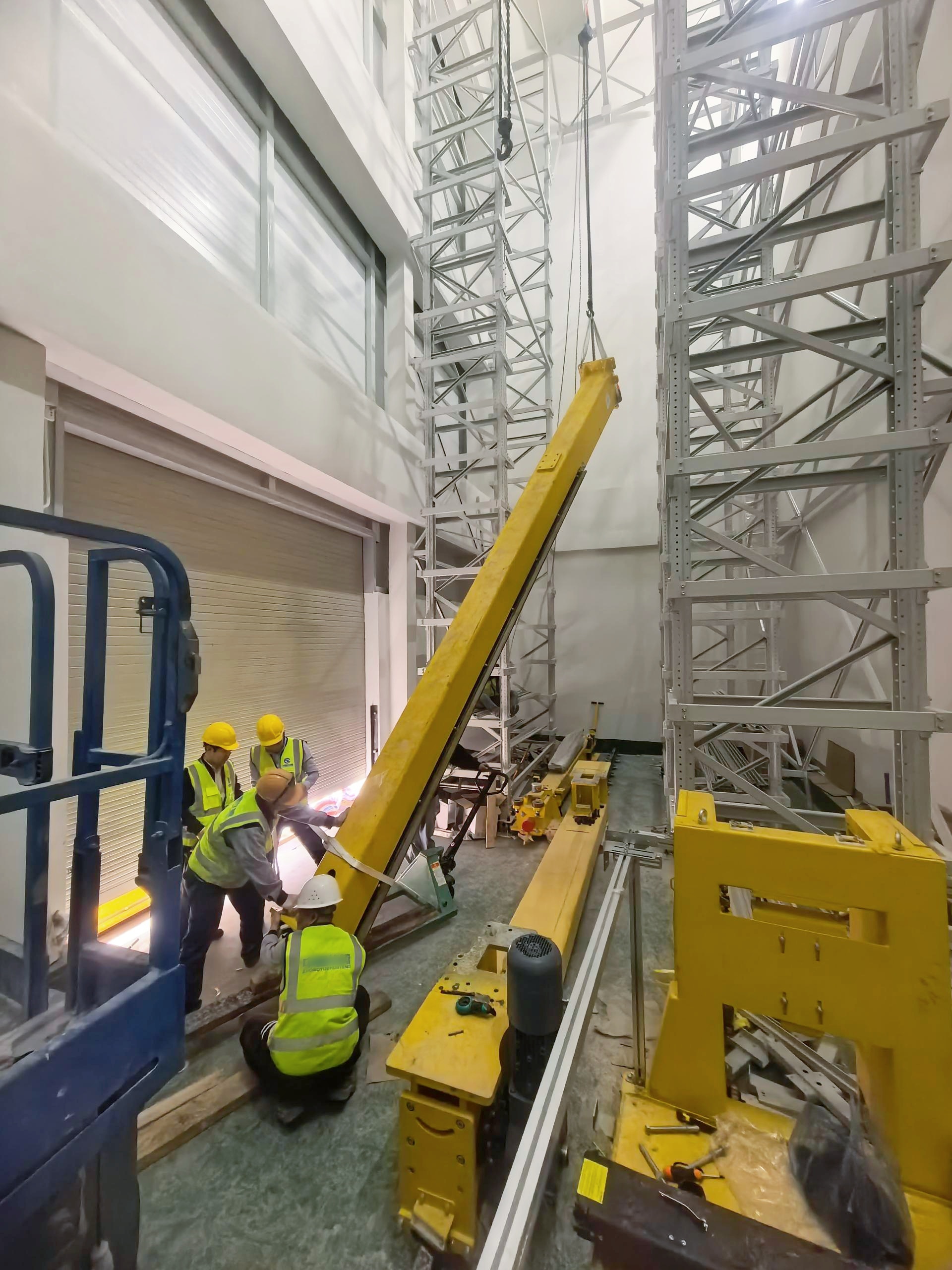
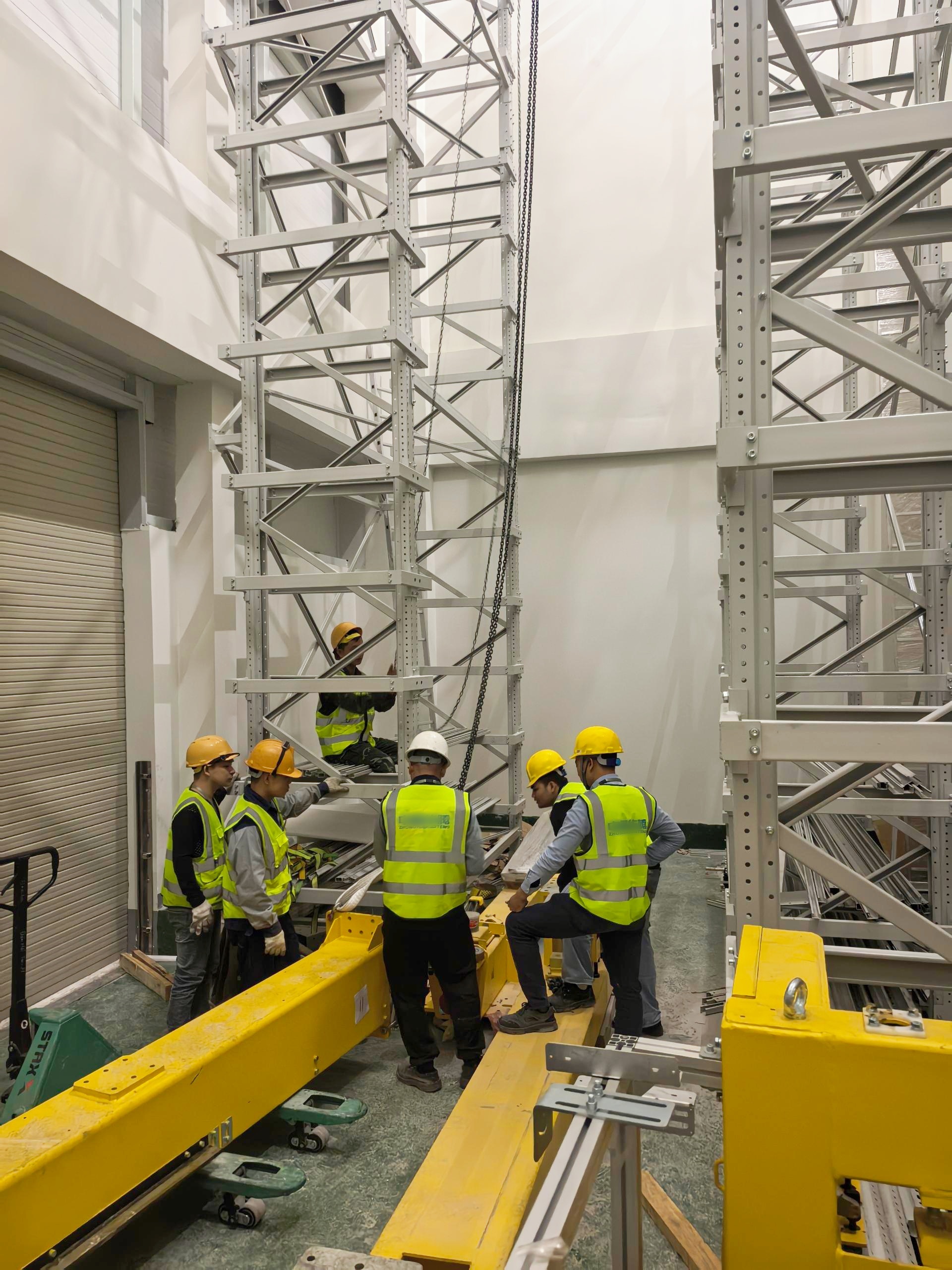
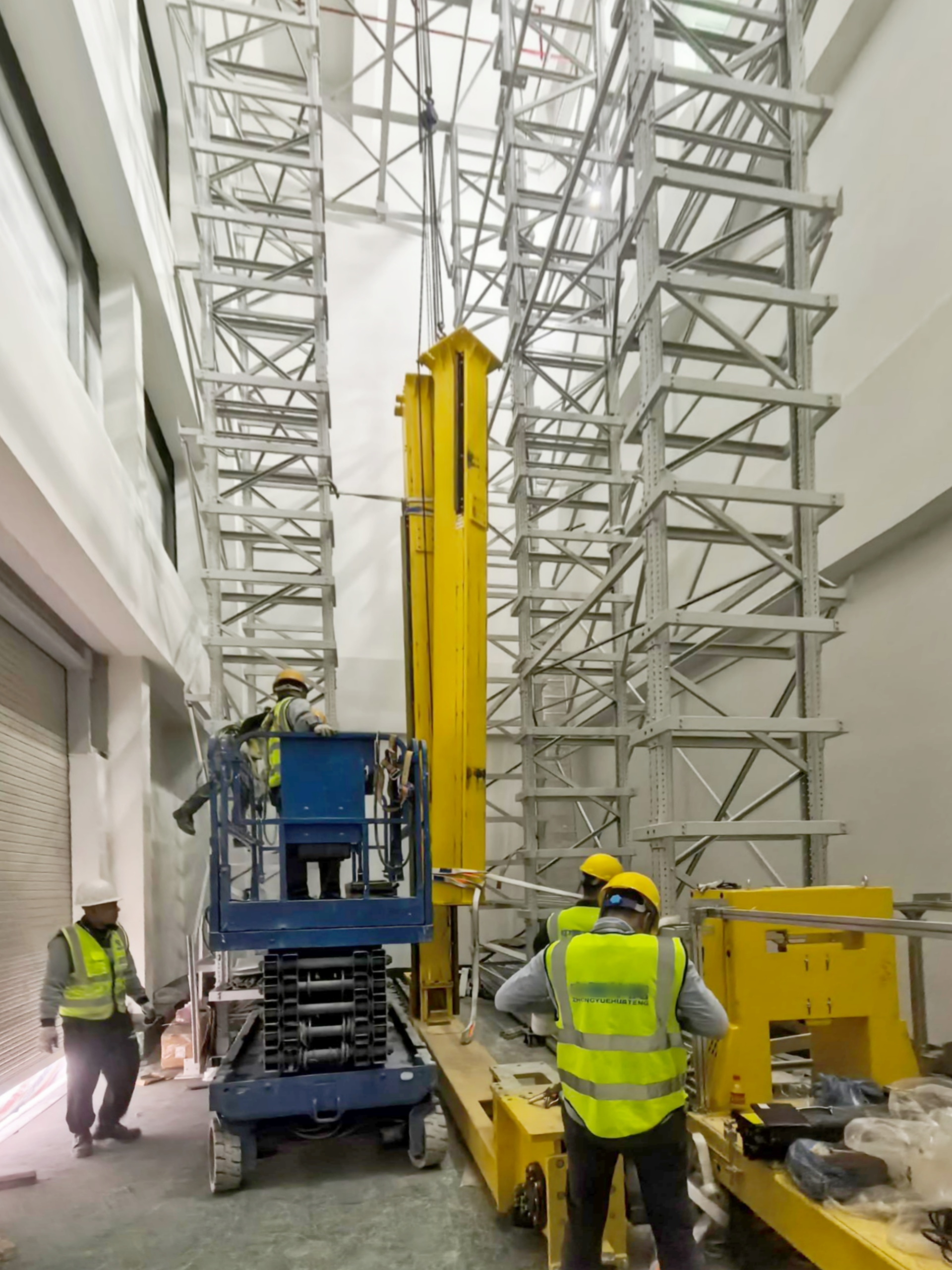
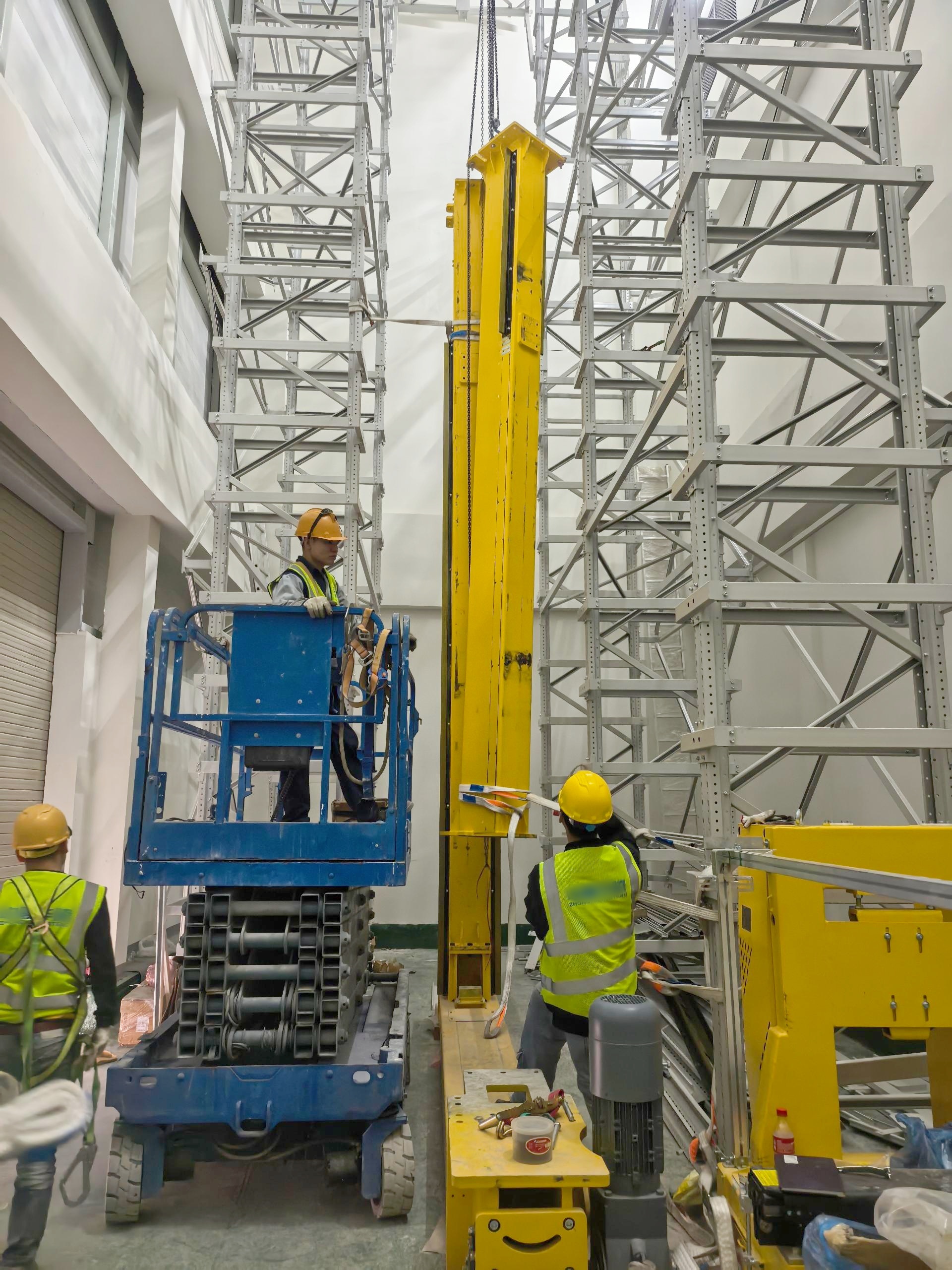
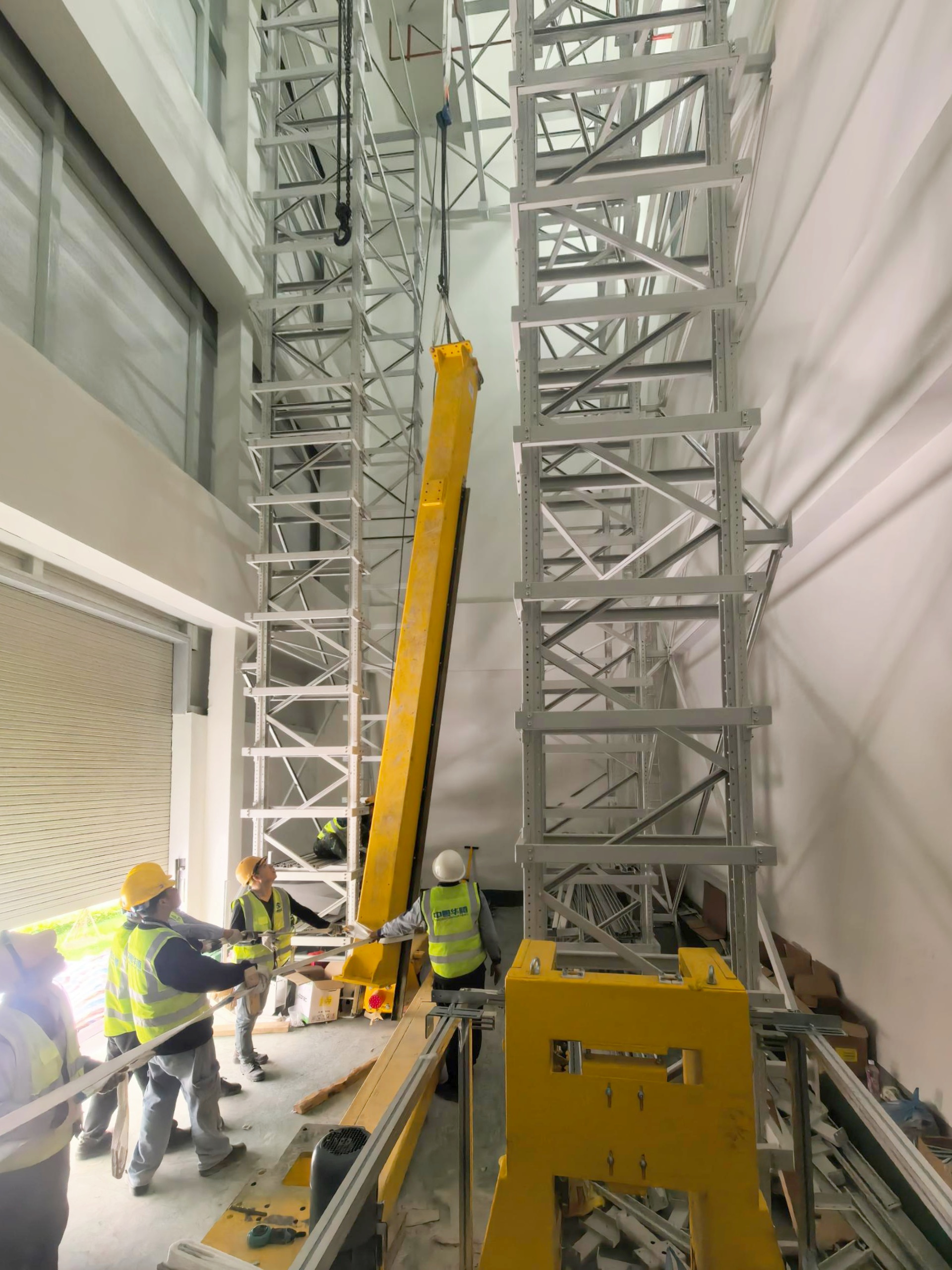
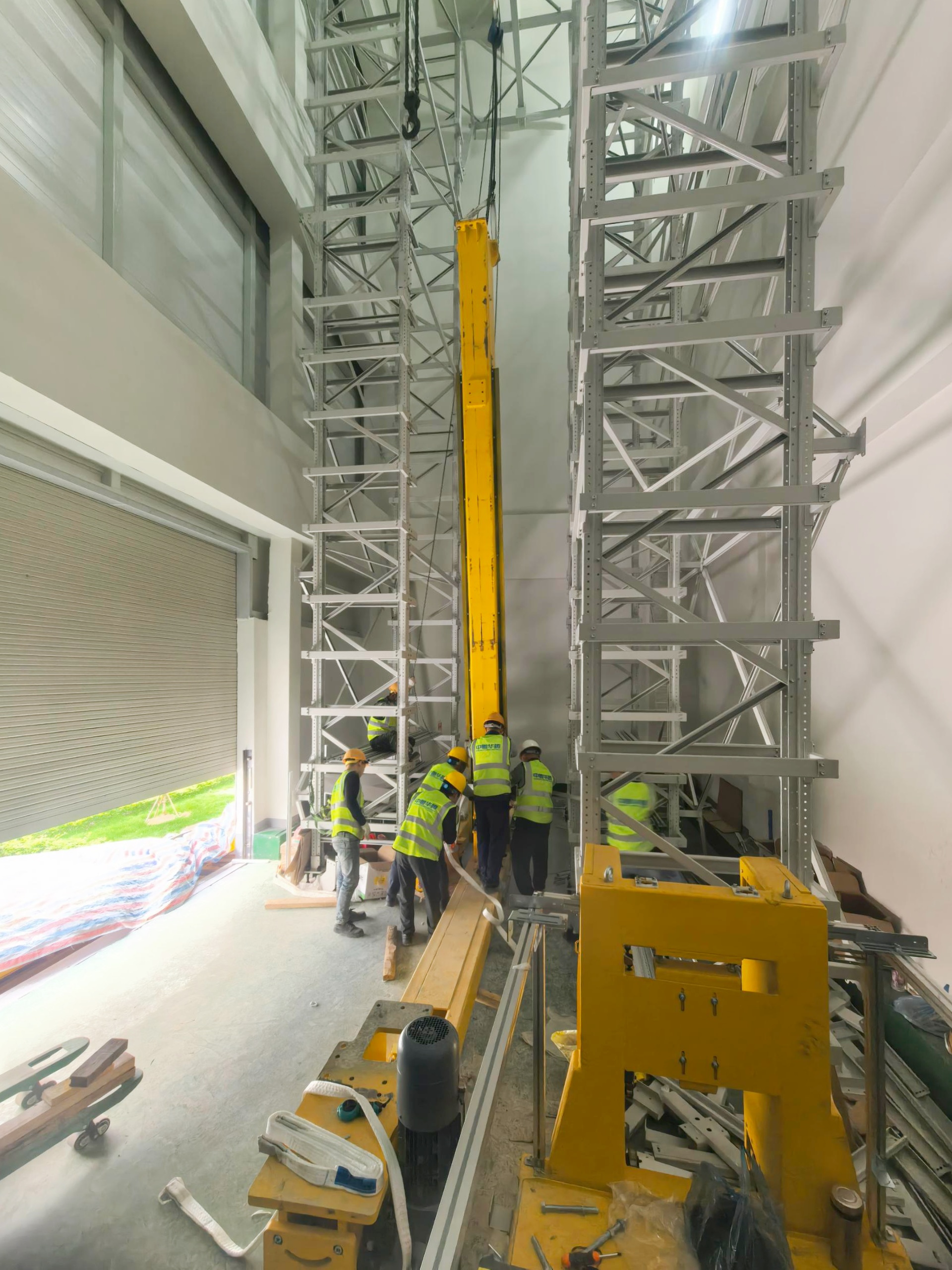
The pictures below show the full process of stacker installation and commissioning—a professional engineering practice ranging from precision hoisting and accurate positioning to intelligent linkage. Every step directly determines the operational efficiency and long-term reliability of the automated warehousing system.
1. Precision Hoisting: Safe & Accurate Placement of Heavy Equipment
As the core operating equipment of an AS/RS, the hoisting and positioning of stackers mark the critical starting point of project implementation:
- Professional Hoisting Plan Given the heavyweight structure of stackers (with a single unit weighing several tons), the project team adopts a sectional hoisting + overall assembly method. Professional lifting equipment and multi-point lifting design ensure even force distribution and stable posture during hoisting, preventing structural deformation and component damage.
- Precise Positioning Control Using laser positioning instruments and 3D modeling technology, the horizontal and vertical deviations of stackers are controlled within ±2 mm, ensuring full alignment between the running track and racking positions, laying a solid foundation for high-speed and high-precision access operations.
- Safety Protection Syste On-site operations strictly follow the safety specification of one person, one supervision; one machine, one plan. Equipped with anti-fall devices, limit sensors and emergency braking systems, the hoisting status is monitored in real time to eliminate hidden dangers such as overturning and collision.
2. Accurate Installation: Full-Process Control from Structure to Electricity
The installation quality of stackers directly affects system stability. A professional team implements full-process control through standardized procedures:
- Structural Installation Accuracy Key components such as columns, beams and traveling mechanisms adopt bolt pre-tightening force control to ensure connection strength and rigidity. Track installation uses dual detection of parallelism and straightness, with deviations controlled to 1/3 of industry standards, guaranteeing stable, shake-free high-speed operation.
- Electrical System Integration Power cables and signal cables are laid in layers with shielding design to avoid electromagnetic interference. Core sensors such as encoders and limit switches are repeatedly calibrated, ensuring position feedback accuracy up to ±1 mm and providing reliable operating data for the WCS system.
- Commissioning & Optimization After installation, three-level tests (no-load, half-load, full-load) are conducted to repeatedly adjust the running speed, acceleration and positioning accuracy of the stacker. Aiming at the coordination between racks and equipment, access paths and motion sequences are optimized to reduce single-cycle operation time to a leading industry level.
3. Intelligent Linkage: In-Depth Collaboration Between Stacker & Racking System
The stacker is not an isolated operating device, but an intelligent unit deeply integrated with racks and the WMS/WCS system:
- Accurate Slot Matching Through laser ranging and visual recognition, the stacker automatically identifies the position and status of rack slots, enabling blind storage and blind retrieval with a positioning accuracy of ±5 mm, supporting over 120 access operations per hour for a single device.
- Fault Self-Diagnosis & Early Warning The built-in sensor network monitors key indicators such as motor temperature, bearing vibration and track wear in real time. AI algorithms provide early warning of potential failures, and the remote operation & maintenance system enables predictive maintenance, reducing downtime by more than 80%.
- Data-Driven Operation Optimization Stacker operating data is connected to the WMS system in real time, supporting intelligent strategies such as dynamic slot allocation, path optimization and urgent order insertion. Warehousing operations shift from fixed processes to adaptive optimization, greatly improving order response speed and inventory turnover efficiency.
4. Full-Life Cycle Support: Professional Services from Delivery to Operation
The value of an AS/RS lies not only at delivery, but also in stable operation throughout its full life cycle:
- Professional O&M Team We provide 7×24-hour remote monitoring and on-site response services. Core failures are handled on-site within 4 hours, and general failures are resolved within 24 hours, maximizing the continuity of enterprise production and logistics.
- Iteration & Upgrade Support As business grows, stacker speed improvement, load expansion and function iteration are supported, ensuring the automated warehousing system always adapts to enterprise development and avoiding repeated investment and resource waste.
- Training & Empowerment We provide professional operation and maintenance training for customers to cultivate an in-house O&M team, realizing a dual guarantee of independent operation + professional support and reducing long-term dependency costs.
From the safe placement in precision hoisting, full-process control in accurate installation, to in-depth collaboration in intelligent linkage, the installation and commissioning of stackers is the core part of an AS/RS project.
With professional technology, rigorous procedures and full-life cycle services, we ensure that every system operates efficiently, stably and intelligently, providing solid support for enterprises to build modern intelligent warehouses.
 StorLogi